Peter’s orphanhood
The Magician's ElephantPeter’s orphanhood is not a single loss but a sequence: his father dies on the battlefield, his mother dies after giving birth to Adele, and the two children are separated before Peter can keep his promise to protect his sister. The memory of his father catching him after each playful toss gives that history its emotional shape. For Peter, being an orphan means not only losing his parents, but living with an unfinished duty and the question of whether anyone will welcome him back.
Family and the promise of return
Peter’s parents appear in a memory of a garden at dusk, when he is small. The sky is purple, lamps have been lit, and his mother wears a white dress while carrying the child who will be Adele. His father lifts Peter and tosses him into the air, catching him again and again. His mother laughs and warns his father not to drop him; his father answers that Peter will always return to him. The repeated gesture makes return something Peter first knows through his father’s arms: a brief suspension followed by safety, warmth, and a waiting parent.
That memory matters because it belongs to a time before the family was broken apart. Peter’s mother is still alive, Adele has not yet been born, and his father’s promise seems secure. In retrospect, the scene’s repetition carries a second meaning. Peter is repeatedly caught, but the protection represented by the game cannot keep the family together. The remembered certainty of being received stands against the later facts of death, separation, and a childhood directed by someone else.
Death and separation
Peter tells Leo Matienne and Gloria Matienne that his father was a soldier who died on the battlefield. Vilna Lutz had served and fought beside him, and was his friend. It was Vilna who came to Peter’s home to deliver the news. The news is followed almost immediately by another crisis: Peter’s mother hears it, Adele begins to come, and Peter’s mother dies after giving birth. In Peter’s account, bereavement and birth are bound together, but the arrival of a sister does not restore the family that has been lost.
Before her death, Peter’s mother makes him promise to watch over the baby. He accepts that responsibility, but the promise is defeated by events outside his control. The midwife takes Adele away, while Vilna takes Peter with him to teach him how to be a soldier. Peter is therefore separated not only from both parents but from the sister he has pledged to protect. His orphanhood is shaped by this double displacement: the children lose their mother, then lose one another, and Peter is removed into a new life before he can fulfill what he promised.
Vilna’s place in this history is consequently complicated. He was Peter’s father’s friend and the bearer of the news of his death; afterward he became Peter’s guardian and military instructor. Gloria reacts with anger when Peter recounts what happened, shouting Vilna’s name and threatening to confront him, while Leo asks her to sit down. The scene shows that Peter’s account can make the old injury visible to others, but it does not erase the fact that the separation had already taken place.
Memory and the need to be welcomed
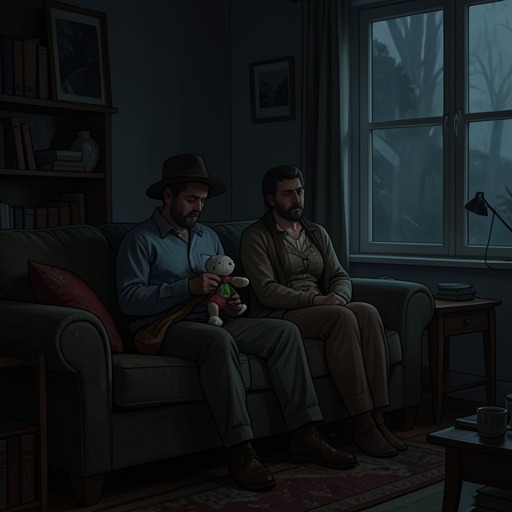
Peter recalls the garden after turning away from Vilna and looking through a window at the darkening world. Below, a door slams, then another; Peter hears laughter and understands that Leo is being welcomed home by his wife. He wonders what it is like to have someone who knows a person will return and greets that return with open arms. That thought leads directly into the memory of his father catching him. The transition links his present loneliness to a specific lost relationship rather than treating orphanhood as an abstract condition.
The contrast is precise: Leo’s homecoming is audible in the present, while Peter’s parents survive in memory. His father’s confidence that the boy would come back is preserved, but the assurance no longer has a living parent to fulfill it. The scene also shows that Peter measures belonging through acts of reception—someone waiting, a door opening, arms ready to catch or embrace—not merely through having a place to stay. The remembered game supplies an image of security; his question reveals how absent that security feels to him now.
A changed meaning of return
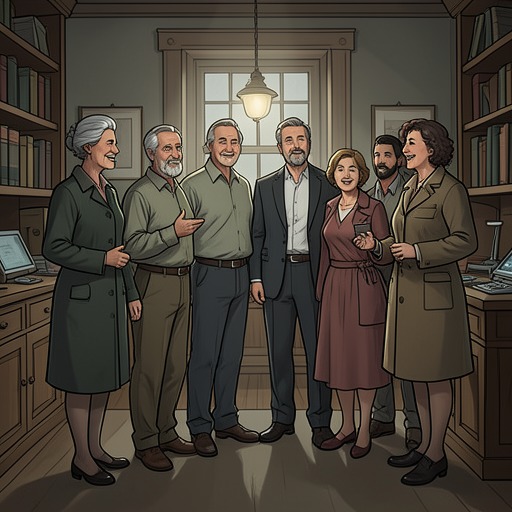
Peter’s separation from Adele makes his promise to their mother a lasting measure of his actions. When he later travels through the snowy streets with the group taking the elephant home, he walks in front of the elephant carrying Adele. Leo walks beside him; Madam LaVaughn is pushed in her wheelchair by Hans Ickman, and the others follow. Peter is no longer the small child suspended in his father’s game. He is carrying his sister, while leading a group whose members have joined the same journey.
The scene does not undo the deaths or restore the childhood family pictured in the garden. Instead, it brings Peter and Adele together in a concrete reversal of their separation: the child he could not protect when they were taken apart is now in his arms. Across the story, the idea of return shifts from his father’s promise, to Peter’s longing for a welcome, and finally to a journey he helps lead. His orphanhood remains part of his history, but it no longer describes his only relation to family or his capacity to act on his mother’s charge.